Radon is an invisible, odorless, radioactive gas that can enter homes from the soil beneath and around a property. Because you cannot see or smell radon, testing is the only reliable way to determine whether elevated levels are present in your home. The Centers for Disease Control and Prevention states that radon can build up indoors and that long-term exposure to high levels can increase the risk of lung cancer.
For homeowners who are unfamiliar with the process, the difference between a radon test vs mitigation can be confusing. Testing tells you how much radon is present. Mitigation is the process used to reduce elevated radon levels.
These are two different but closely connected steps. A test should generally precede mitigation because the results help determine whether action is necessary and which radon reduction approach may be appropriate.
For Colorado homeowners, understanding the difference can make it easier to protect your home and make informed decisions about professional radon services.
What Is a Radon Test?
A radon test measures the concentration of radon in the air inside your home. Results are commonly reported in picocuries per liter, or pCi/L.
Unlike problems such as water leaks or mold, radon does not provide obvious warning signs. You cannot determine the radon level in your home simply by looking at the foundation or checking whether your house has a basement.
The CDC emphasizes that testing is the only way to know whether a home has elevated radon levels.
A radon test can be performed using a short-term or long-term testing method. Homeowners may use a qualified professional or, depending on the circumstances, a do-it-yourself test kit.
Short Term Radon Testing
Short-term tests generally measure radon over a relatively brief period. They can be useful when homeowners need a faster indication of current indoor radon levels, including during a real estate transaction.
However, radon concentrations can fluctuate because of weather, ventilation, building conditions, and other factors. A single test therefore may not tell the complete story.
If a short-term test shows a result at or above 4 pCi/L, the CDC recommends additional testing in many circumstances before making a mitigation decision, depending on the testing situation.
Long Term Radon Testing
Long-term testing measures radon for more than 90 days and can provide a better representation of average exposure over time.
Because radon levels can change from day to day and season to season, longer testing can provide useful information about the home’s typical radon concentration.
The appropriate testing method depends on the reason for testing and the circumstances of the property.
What Is Radon Mitigation?
Radon mitigation is the process of reducing radon levels inside a home.
Unlike testing, mitigation does not measure the amount of radon present. Instead, it uses proven techniques to prevent radon from entering the living space or to remove radon from beneath the home before it can accumulate indoors.
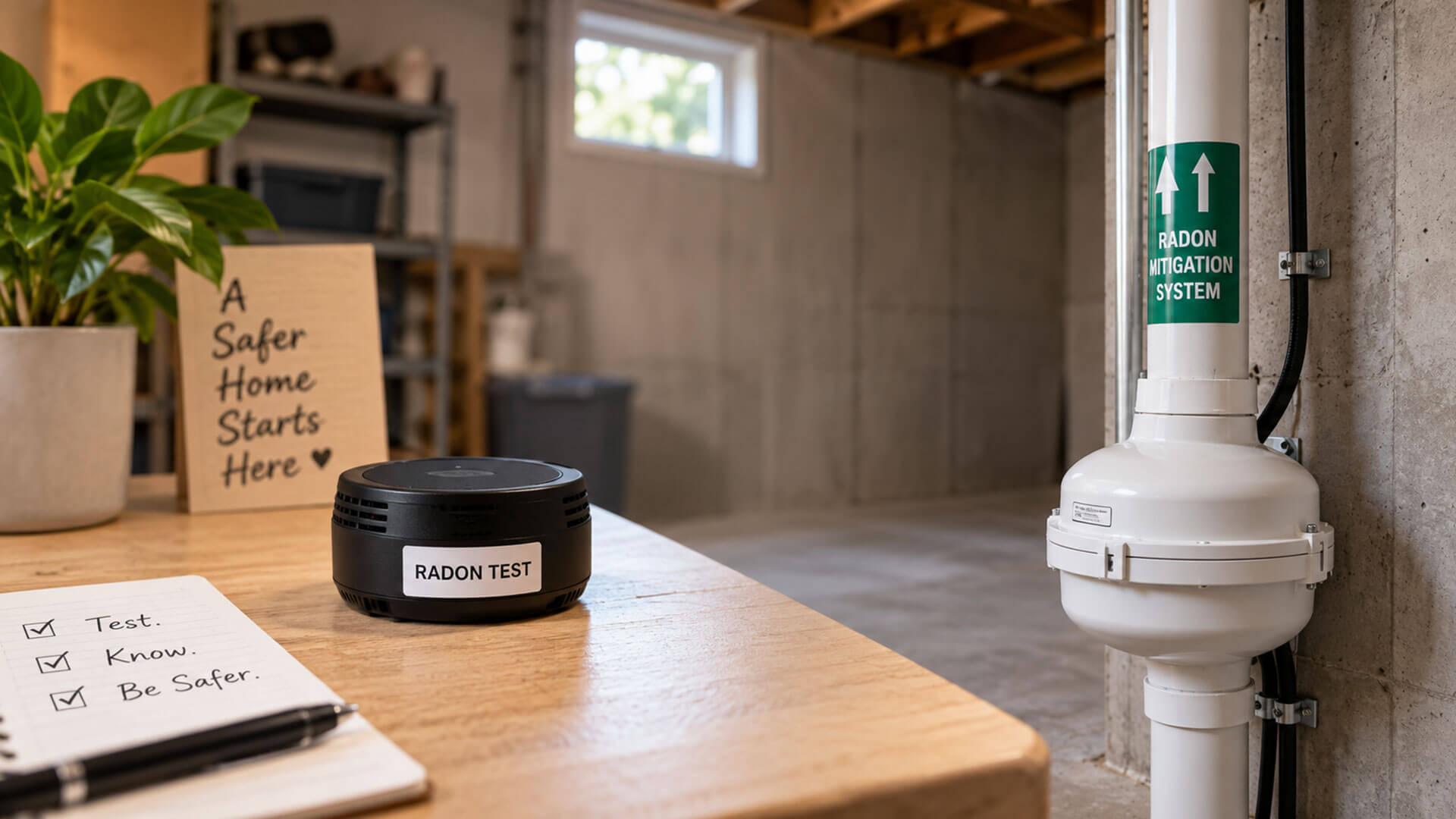
One of the most common approaches uses an active soil depressurization system. A pipe and fan create suction beneath the home, draw radon-laden soil gas away from the foundation, and exhaust it safely outside.
The EPA reports that some radon reduction systems can reduce indoor radon levels by up to 99 percent, although results depend on the home and the mitigation system used.
This distinction is important:
Radon testing answers: “How much radon is in my home?”
Radon mitigation answers: “What can we do to reduce it?”
Radon Test vs. Mitigation: The Key Difference
The simplest way to understand radon test vs mitigation is to think of testing as diagnosis and mitigation as correction.
A test identifies the level of radon in the home. Mitigation addresses the problem when elevated levels are found.
| Radon Testing | Radon Mitigation |
| Measures indoor radon | Reduces indoor radon |
| Produces a radon level | Uses a reduction system |
| Helps determine whether action is needed | Addresses elevated radon |
| Usually comes first | Usually follows elevated test results |
| Does not remove radon | Designed to reduce radon exposure |
Both are important, but they serve completely different purposes.
You should not install a mitigation system simply because you have heard that radon exists in your area. At the same time, you should not ignore an elevated test result simply because your home looks well sealed.
Testing provides the information needed to make a responsible decision.
What Radon Levels Mean
Understanding your test results is one of the most important parts of the process.
The EPA recommends fixing a home when the radon level is 4 pCi/L or higher. The agency also recommends considering action when levels are between 2 and 4 pCi/L, because there is no known completely safe level of radon exposure.
The CDC provides similar guidance, recommending a radon reduction system when indoor radon levels are at or above 4 pCi/L and encouraging homeowners to consider reducing levels between 2 and 4 pCi/L.
Here is a general way to interpret results:
Below 2 pCi/L
This is below the EPA action level. Continued testing may still be appropriate, especially if you make major changes to your home or begin using a lower level as living space.
2 to 4 pCi/L
The EPA recommends considering action to reduce radon exposure in this range. Homeowners may want to discuss their options with a qualified radon professional.
4 pCi/L or Higher
This is the EPA action level. Homeowners should take steps to reduce radon, generally through a professionally designed mitigation system.
Why Radon Levels Can Change
Radon levels are not necessarily constant.
Concentrations can change based on weather, soil conditions, ventilation, pressure differences, construction changes, and how a home is used.
For example, finishing a basement and turning it into a bedroom or home office can increase the importance of knowing the radon level in that part of the home.
The CDC recommends testing before and after renovations and when a lower level of a home is converted into living space.
When to Mitigate Radon
So, when to mitigate radon is a common question.
If your home has a radon level at or above 4 pCi/L, the EPA recommends fixing the home. If levels are between 2 and 4 pCi/L, consider taking action to reduce exposure.
However, the decision should be based on reliable testing and the specific circumstances of the property.
If you receive an unexpectedly high result from a short term test, a qualified professional can help determine whether additional testing is appropriate and what the next step should be.
Homeowners should also consider mitigation when:
- A previous test showed elevated radon
- A home has never been tested
- A basement is being converted into living space
- Major renovations have changed the foundation or ventilation
- A previous mitigation system is no longer functioning properly
- Post-mitigation testing shows that radon remains elevated
- A real estate transaction identifies elevated radon
The goal is to make decisions based on actual measurements rather than assumptions.
How Radon Reduction Systems Work
A radon mitigation system is designed around the way soil gas moves beneath a building.
In many homes, the system uses a suction point beneath the foundation. A fan creates negative pressure below the home, pulling soil gas into a pipe. The gas is then routed outdoors rather than allowing it to enter the living area.
The CDC identifies radon reduction systems as a proven way to reduce indoor radon and recommends using a qualified professional, as high-quality radon reduction work requires technical knowledge and specialized skills.
Depending on the home’s construction, a mitigation system may use:
- Sub-slab suction
- Sump suction
- Drain tile suction
- Crawl space depressurization
- Soil suction beneath a membrane
- Passive radon system activation
There is no single system that works identically for every home. Foundation type, soil conditions, construction materials, and the home’s layout all influence the appropriate design.
Why Sealing Cracks Is Not the Same as Mitigation
Homeowners sometimes assume that sealing foundation cracks is enough to solve a radon problem.
Sealing cracks and openings can be useful as part of a broader radon reduction strategy, but it is not necessarily a substitute for an active mitigation system.
Radon can enter through multiple pathways, including cracks, construction joints, openings around pipes, sump openings, and other areas where the home connects with the soil.
A professionally designed mitigation system addresses the pressure conditions that can pull soil gas into the home.
In other words, sealing may reduce potential entry points, while active mitigation is designed to capture and exhaust radon before it accumulates inside.
Does Radon Mitigation Really Work?
Yes. Properly designed and installed radon reduction systems can significantly lower indoor radon concentrations.
The EPA reports that some radon reduction systems can reduce indoor radon levels by up to 99 percent.
However, installation is not the final step.
The home should be tested again after mitigation to confirm that radon levels have been reduced. The CDC specifically recommends retesting after repairs to determine whether they successfully lowered radon concentrations.
A mitigation system should also be monitored over time. If a fan stops working or another part of the system develops a problem, radon levels could rise again.
Can New Homes Have High Radon Levels?
Yes.
Radon is not limited to older homes or homes with obvious foundation problems. The CDC notes that radon can occur in homes regardless of whether they are new or old, sealed or drafty, or have a basement.
The EPA also recommends testing newly built homes even when radon-resistant construction features have been incorporated.
This is another reason testing matters. The age or appearance of your home cannot tell you whether radon levels are elevated.
Why Professional Radon Services Matter
Radon mitigation is not simply a matter of installing a fan.
The system needs to be appropriately designed for the structure, installed correctly, and verified through follow-up testing.
An improperly installed system may not provide the expected reduction and could create unintended issues.
The CDC recommends working with qualified professionals because reducing high radon levels requires technical knowledge and specialized skills.
A professional can help evaluate your test results, identify potential entry pathways, determine the appropriate mitigation strategy, and explain how the system should be monitored after installation.
Radon Testing and Mitigation With Aspen Radon
Understanding the difference between a radon test vs mitigation is the first step toward making informed decisions about your home.
Testing tells you whether elevated radon levels are present. Mitigation is the next step when those levels require reduction.
For Colorado homeowners, Aspen Radon can help make the process easier to understand. Instead of guessing whether your home needs a mitigation system, start with reliable testing and use the results to determine the appropriate next step.
Whether you are concerned about an existing home, buying a property, selling your home, or planning a renovation, knowing your radon levels gives you information you can act on.
Frequently Asked Questions
Is radon testing the same as radon mitigation?
No. Radon testing measures the amount of radon in the indoor air. Mitigation involves installing measures designed to reduce elevated radon levels.
Should I test before installing a mitigation system?
Yes. Testing provides the information needed to determine whether elevated radon is present and helps guide the next step.
What radon level requires mitigation?
The EPA recommends fixing a home when radon levels reach 4 pCi/L or higher. It also recommends considering action for levels between 2 and 4 pCi/L.
How long should I wait before retesting after mitigation?
Follow the recommendations of your mitigation professional and the applicable testing guidance. The CDC recommends testing again after repairs to confirm that radon levels have been reduced.
Can I lower radon without installing a mitigation system?
Some measures, such as sealing certain openings and improving ventilation, may help reduce exposure, but they are not necessarily a substitute for a properly designed radon reduction system when levels are elevated.
Can radon levels change after a mitigation system is installed?
Yes. Building conditions, weather, ventilation, system performance, and other factors can affect radon levels. Periodic testing helps verify that the home continues to have appropriately low radon concentrations.
Do I need radon testing if my neighbor has high radon?
Yes. Nearby homes can have different radon levels because of differences in construction, foundation type, soil conditions, and other factors. Testing your own home is the only way to determine its radon level.
Can a radon test be done during a home sale?
Yes. Radon testing is commonly performed during real estate transactions. The EPA recommends testing when buying or selling a home.
Take the Next Step With Aspen Radon
You do not have to guess whether radon is a concern in your home.
A professional radon test can give you measurable information about your indoor radon levels. If the results are elevated, the next step may be a professionally designed radon reduction system.
Aspen Radon can help you understand your results and determine what to do next.
U.S. Government Radon Resources
For additional information, homeowners can review these government resources:
- U.S. Environmental Protection Agency: What Is EPA’s Action Level for Radon?
- U.S. Environmental Protection Agency: How Much Can a Radon Mitigation System Cost?
- Centers for Disease Control and Prevention: Testing for Radon in Your Home
- Centers for Disease Control and Prevention: Reducing Radon Levels in Your Home
- U.S. Environmental Protection Agency: How to Address Radon When Building a New Home